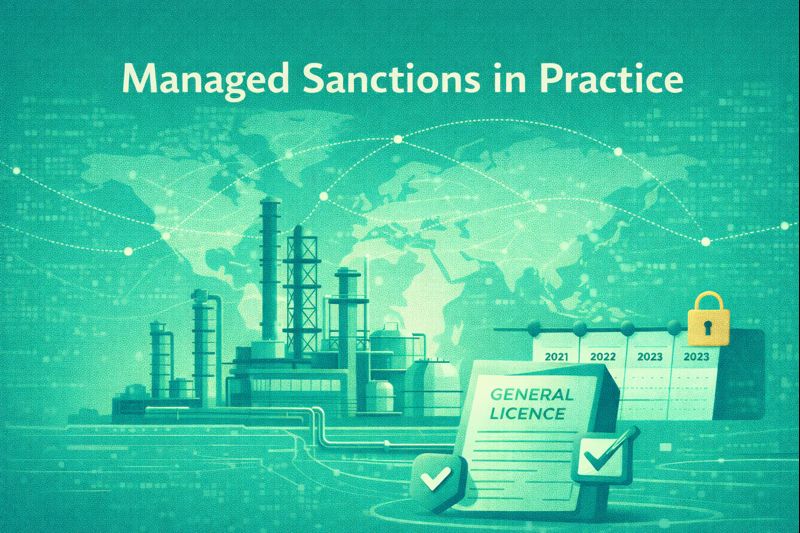
- Executive Summary
- 1. The Core Question: Why Was NIS Not Shut Down Immediately?
- 2. Serbia’s Role: Reframing Corporate Risk as National Security
- 3. The United States: Preserving Sanctions Credibility Through Flexibility
- 4. The European Union: Silent Consent in the Name of Regional Stability
- 5. Corporate Execution: NIS as a “Managed Operator,” Not a Sanctions Loophole
- 6. Structural Insight: Sanctions Have Entered a Managerial Phase
- Conclusion: What the NIS Case Ultimately Teaches Us
Executive Summary
The temporary continuation of operations at Serbia’s oil major NIS under Western sanctions was not the result of political leniency toward Russia.
It was the outcome of a converging set of interests—among Serbia, the United States, and the European Union—at a critical point where sanctions effectiveness, regional stability, and energy security intersected.
This case illustrates a broader shift in sanctions policy:
from blunt exclusion toward managed enforcement, where the objective is not maximum disruption, but maximum strategic effect with minimal collateral damage.
1. The Core Question: Why Was NIS Not Shut Down Immediately?
At the heart of the decision lay a simple cost–benefit calculation.
An immediate halt to NIS operations would have:
- Severely disrupted Serbia’s domestic fuel supply
- Triggered price spikes and social instability
- Created spillover risks across the Balkans and parts of the EU
Crucially, these effects would have undermined the strategic purpose of sanctions: constraining Russia without destabilizing neighboring states.
Thus, allowing NIS to continue operating for a limited period was assessed as the lesser of two strategic evils.
2. Serbia’s Role: Reframing Corporate Risk as National Security
For セルビア, the decisive move was to elevate NIS from a corporate asset to a pillar of national energy security.
The Serbian government consistently argued that:
- NIS is a systemically important supplier
- Its shutdown would not punish Russia proportionately
- The resulting instability would weaken, not strengthen, the sanctions coalition
By framing the issue in energy-security and social-stability terms, Serbia aligned its case with Western strategic priorities rather than opposing them.
3. The United States: Preserving Sanctions Credibility Through Flexibility
From Washington’s perspective—particularly within 米国財務省外国資産管理局—the decision was not a concession, but an enforcement choice.
The logic was consistent with OFAC’s broader doctrine:
- Sanctions are tools to shape behavior, not punish indiscriminately
- Temporary licences can enhance, not dilute, long-term pressure
- Destabilizing friendly or neutral states weakens sanctions credibility
Granting a time-bound allowance to NIS was therefore a way to protect the sanctions regime from self-inflicted failure.
4. The European Union: Silent Consent in the Name of Regional Stability
The 欧州連合 played a quieter, but decisive role.
Although the EU did not publicly champion NIS, it also did not obstruct the arrangement.
This tacit consent reflected pragmatic concerns:
- Balkan energy flows are tightly interconnected with EU markets
- Sudden supply disruptions would feed inflationary pressures
- Political instability in Serbia would reverberate regionally
In effect, the EU prioritized containment of secondary risks over symbolic enforcement.
5. Corporate Execution: NIS as a “Managed Operator,” Not a Sanctions Loophole
NIS itself mattered.
By demonstrating:
- Strict operational containment
- Transparency toward regulators
- A commitment to “maintenance-only” continuity rather than expansion
the company positioned itself not as a sanctions evader, but as a managed risk.
This distinction proved critical. Sanctions authorities are far more willing to tolerate continuity when it prevents disorder rather than generates profit-driven circumvention.
6. Structural Insight: Sanctions Have Entered a Managerial Phase
The NIS case highlights a structural transformation in sanctions policy.
Modern sanctions aim to:
- Degrade an adversary’s strategic capacity
- Avoid destabilizing the surrounding system
- Operate through licences, exceptions, and timelines
In this framework, temporary tolerance is not weakness, but an enforcement strategy.
Conclusion: What the NIS Case Ultimately Teaches Us
The continuation of NIS operations was not about protecting Russia.
It was about protecting the integrity of sanctions themselves.
The broader lesson is clear:
Effective sanctions are no longer those that halt everything immediately,
but those that can be calibrated, managed, and sustained over time.
In this sense, the NIS case is not an exception—it is a preview of how economic statecraft will increasingly be practiced in a fragmented, energy-constrained world.
For policymakers, corporations, and analysts alike, the implication is profound:
the future of sanctions lies not in absolute prohibition, but in controlled continuity.