Why Isolated States Survive Without Allies
- Executive Summary
- 1. Why “Allies” No Longer Exist for Venezuela
- 2. Political Patrons: Strong Voices, Weak Support
- 3. Sanctions-Experienced Partners: Survival, Not Recovery
- 4. Pragmatic Partners: Flexible, Interest-Driven Links
- 5. The Most Important Actor: Not an Ally, but a Hub
- 6. Economist’s Synthesis: Why No One Fully Defends Venezuela
- Conclusion
Executive Summary
Venezuela is not completely isolated from the international community.
However, it lacks any true ally willing to underwrite the cost of its survival. What exists instead is a fragmented network of:
- States that provide political rhetoric,
- States that maintain limited transactions, and
- States that act as functional hubs under sanctions.
This structure reveals a critical truth about the modern global order: alliances have been replaced by selective, cost-minimized connectivity.
1. Why “Allies” No Longer Exist for Venezuela
In the Cold War era, a friendly country meant a partner willing to provide:
- Military protection
- Economic assistance
- Collective diplomatic defense
simultaneously.
In Venezuela’s case, these functions are no longer bundled.
They are disaggregated across different actors, none of whom assume full responsibility.
As a result, no comprehensive alliance exists.
2. Political Patrons: Strong Voices, Weak Support
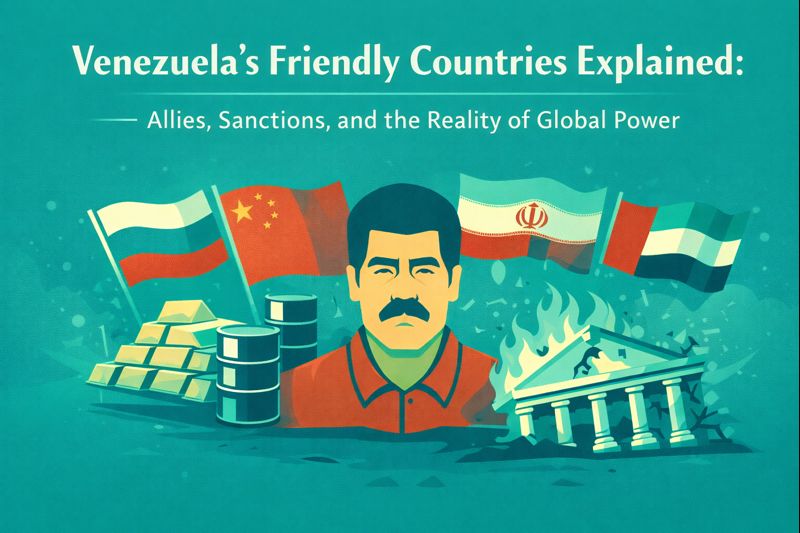
Russia
Russia has been the most vocal defender of the Maduro government.
- Diplomatic backing in international forums
- Symbolic military cooperation
- Rhetorical opposition to U.S. actions
Yet Russia itself is heavily sanctioned and fiscally constrained.
Its support is discursive, not material. It cannot offer sustained capital, technology, or market access.
China
China maintains formal relations based on:
- Non-interference principles
- Past oil-backed lending
- Opposition to unilateral sanctions
However, in recent years China has:
- Halted new large-scale financing
- Reduced project exposure
- Prioritized capital recovery over political loyalty
China is neither hostile nor protective—it is risk-aware and transactional.
3. Sanctions-Experienced Partners: Survival, Not Recovery
Iran
Iran cooperates with Venezuela on sanctions circumvention.
- Refining assistance
- Logistics and barter mechanisms
- Operational know-how under isolation
This relationship is about survival techniques, not reconstruction or growth.
Cuba
Cuba is Venezuela’s closest ideological partner.
- Medical and security personnel
- Political solidarity
Yet Cuba lacks the economic capacity to provide meaningful financial or industrial support.
4. Pragmatic Partners: Flexible, Interest-Driven Links
Turkey
Turkey has engaged in:
- Gold trade
- Logistics and commercial intermediation
Its position is deliberately ambiguous and adjustable.
Turkey’s involvement is conditional and reversible, depending on sanctions risk.
Left-leaning Latin American States
Countries such as Bolivia and Nicaragua offer political sympathy.
However, they lack:
- Financial scale
- Military influence
- Institutional leverage
Their support is symbolic rather than decisive.
5. The Most Important Actor: Not an Ally, but a Hub
The UAE’s Unique Role
The United Arab Emirates is often mislabeled as a Venezuelan “friend”.
In reality, the UAE functions as:
- A neutral financial and logistics hub
- A corporate and trading gateway
- A jurisdiction that minimizes political alignment
Crucially:
The UAE does not support Venezuela politically—it enables connectivity without commitment.
It preserves strict distance from state-level sanction violations and prioritizes its strategic relationship with the United States.
6. Economist’s Synthesis: Why No One Fully Defends Venezuela
The explanation is straightforward:
- Defending Venezuela implies accepting
- Secondary sanctions
- Financial exclusion
- Legal and reputational risk
- The returns are
- Uncertain
- Long-dated
- Politically volatile
From a rational cost-benefit perspective:
No state chooses to become Venezuela’s full ally.
This is not ideological failure—it is systemic logic.
Conclusion
Venezuela’s network of “friendly countries” is not an alliance system, but a collection of partial functions:
- Some speak
- Some trade
- Some connect
None rebuild.
This reality underscores a defining principle of the 21st-century international economy:
A state that loses institutional credibility also loses insurance.
Venezuela’s case is therefore not an anomaly—it is a warning.
In a sanctions-based world, sovereignty without institutions is unsustainable, and friendship without risk-sharing is the norm.