China

AI

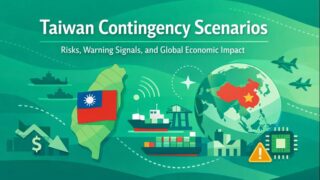
Taiwan Contingency: Ten Plausible Scenarios

This report outlines ten realistic Taiwan contingency scenarios, explaining how military, cyber, economic, and political pressures could shape a future crisis between China, Taiwan, and the United States.
AI

U.S. AI Semiconductor Policy Shifts from “Blockade” to “Managed Competition”

This report analyzes why U.S. policymakers are shifting from AI chip bans to controlled exports, how China intends to leverage H200 access, and what these changes mean for NVIDIA, data centers, and semiconductor markets.
China

Japan–China Political Tensions Intensify

Japan and China entered a new phase of political tension following a dangerous radar lock incident and Beijing’s suspension of cultural exchanges. Our analysis explores military escalation risks, Taiwan-driven strategic friction, and consequences for global markets and supply chains.
China

Geopolitical Report: China’s Aircraft Carrier Fujian Deployment near Taiwan

China’s newest aircraft carrier Fujian has sailed near the Taiwan Strait soon after its commissioning, signaling Beijing’s military confidence and geopolitical intent toward Taiwan and the U.S.–Japan alliance. This report analyzes its operational details, strategic implications, and future scenarios for the Indo-Pacific balance.
China

The Strategic and Financial Appeal of Rare Earth Elements

Rare earth elements are redefining global finance. Their scarcity, geopolitical leverage, and ESG relevance make them a new strategic asset class.
China

🌍 Rare Earth Shock 2025: The Fragmentation of Resource Economics and the New Geopolitical Equilibrium

An in-depth economist report on the 2025 rare earth crisis—how China’s export controls and the Pentagon’s stockpile strategy are redefining global trade, finance, and Japan’s role in economic security.
China

Geopolitical Risk Report on Rare Earths (October 2025)

A comprehensive analysis of the 2025 rare earths crisis—how US–China rivalry, export controls, and defense policies are reshaping global supply chains and Japan’s economic security.
China

Japan’s Strategic Response to the Rare Earth Geopolitics

Japan is building a three-pillar strategy—supply diversification, dual industrial standards, and financial stabilization—to reduce dependence on China and secure critical rare earth materials amid rising geopolitical tensions.
China

Geopolitics of Rare Earths: How Resource Power Reshapes the New Cold War Economy

As U.S.–China tensions escalate, rare earths have become the silent weapon shaping a new Cold War economy. Explore how resource power, supply chain alliances, and technological decoupling are redrawing the global order.
China

China’s Port Fee Retaliation: The Rise of a “Non-Tariff Tariff” in Global Trade

China has imposed new port fees on U.S.-linked vessels, marking the start of a non-tariff trade war. Learn how this “logistics weapon” reshapes global supply chains.
China

Wang Yi’s Visit to Europe: Implications for EU–China Relations and China’s CEE Strategy

Chinese Foreign Minister Wang Yi’s visit to Italy and Switzerland highlights China’s new approach to EU–China relations—balancing de-risking, trade, and financial diplomacy across Europe.
China

The Takaichi Doctrine: How Japan’s First Female Prime Minister Is Redefining the U.S.–Japan Alliance and Countering China’s Rise

Japan’s new Prime Minister, Sanae Takaichi, is reshaping the U.S.–Japan alliance into a comprehensive framework that fuses defense, economic security, and Indo-Pacific strategy. This report examines her emerging doctrine toward China and the implications for regional balance.
China

China’s New “K Visa” – Background, Purpose, and Strategic Benefits

China launches the K Visa in 2025 to attract young STEM professionals, strengthen innovation, and counter restrictive U.S. H-1B reforms.