- Introduction
- 1. The Original Vulnerability: Extreme Resource Dependence
- 2. Political Choices: Mobilization Over Institutions
- 3. Monetary Breakdown: Hyperinflation as an Inevitable Outcome
- 4. Collapse of State Capacity: The PDVSA Failure
- 5. Social Disintegration: Exit from the State
- 6. The Core Diagnosis: An Economist’s Summary
- Conclusion
Introduction
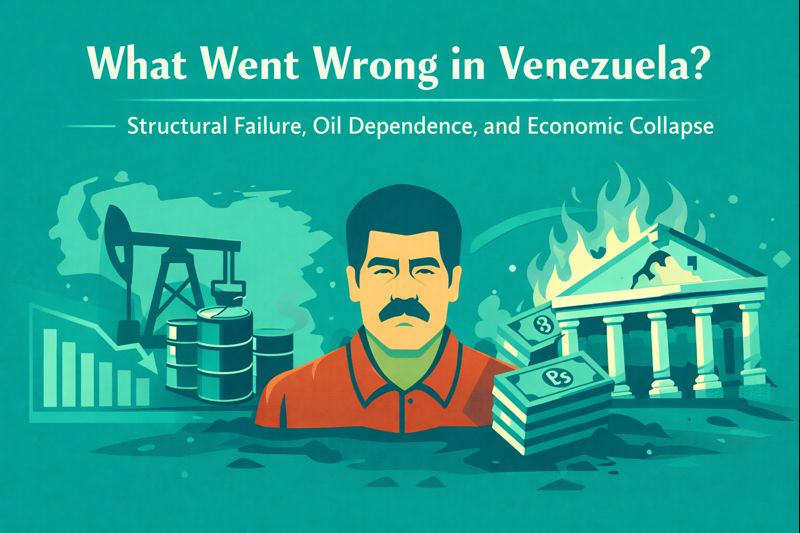
Before sanctions, diplomatic isolation, or leadership disputes became global headlines, Venezuela had already been suffering from deep, self-inflicted structural problems. The country’s crisis was not sudden, nor externally imposed alone; it was the cumulative result of policy choices that systematically dismantled institutions, markets, and credibility.
This section explains what fundamentally went wrong, and why the crisis became irreversible.
1. The Original Vulnerability: Extreme Resource Dependence
1.1 Oil as a Single Point of Failure
Venezuela possesses some of the world’s largest proven oil reserves, yet:
- Government revenue
- Foreign currency earnings
- Public employment
were overwhelmingly dependent on oil exports managed by the state oil company PDVSA.
During periods of high oil prices, this fragility was masked. When prices fell, the entire economic system deteriorated simultaneously. No serious diversification strategy was implemented, locking the country into a single-commodity fate.
2. Political Choices: Mobilization Over Institutions
2.1 Long-Term Populism
From the Chávez era through the presidency of Nicolás Maduro, governance relied on:
- Price controls
- Exchange controls
- Massive subsidies
These tools were politically effective in the short term but destroyed market signals, incentives to produce, and private investment.
Economic management was subordinated to political survival.
2.2 Erosion of Legitimacy
Over time, the government:
- Politicized the judiciary
- Marginalized opposition parties
- Undermined electoral credibility
As legitimacy deteriorated, Venezuela lost diplomatic leverage and became increasingly vulnerable to international pressure and sanctions.
3. Monetary Breakdown: Hyperinflation as an Inevitable Outcome
3.1 Fiscal Deficits Monetized
Persistent fiscal deficits were financed through:
- Central bank money creation
- De facto monetization of government spending
The result was catastrophic:
- The bolívar ceased to function as a store of value
- Hyperinflation destroyed real wages
- Savings were wiped out
Currency collapse was not an accident—it was the predictable consequence of policy.
3.2 Controls That Backfired
Exchange-rate and price controls produced:
- Massive black-market distortions
- Chronic shortages
- Systemic corruption
The formal economy hollowed out, replaced by informal and illicit channels.
4. Collapse of State Capacity: The PDVSA Failure
4.1 Loss of Human Capital
Political loyalty replaced technical competence:
- Experienced engineers were dismissed or emigrated
- Maintenance collapsed
- Output declined sharply
Oil reserves remained underground, but production capability vanished.
4.2 Isolation from Global Infrastructure
Sanctions later compounded problems by cutting access to:
- Dollar settlement
- Insurance and reinsurance
- Drilling, refining, and shipping technology
Venezuela became a paradox: resource-rich yet operationally incapacitated.
5. Social Disintegration: Exit from the State
The economic collapse triggered:
- Severe food and medicine shortages
- Breakdown of public services
- Rising insecurity
Millions of Venezuelans emigrated, signaling not just economic hardship but partial state failure.
6. The Core Diagnosis: An Economist’s Summary
Venezuela’s crisis can be reduced to one central failure:
Institutions were sacrificed to sustain political control,
causing the simultaneous collapse of the economy, the currency, and sovereignty itself.
The country did not lack resources or people.
It lost institutional credibility.
Once credibility disappeared, markets closed, capital fled, and sanctions became both easier to impose and harder to escape.
Conclusion
Venezuela’s tragedy cannot be explained solely by oil prices, foreign pressure, or geopolitics.
The decisive factor was systematic institutional erosion, which left the country unable to absorb shocks or adapt.
This lesson is universal:
Resource wealth cannot substitute for credible institutions.
Without them, sovereignty becomes fragile—and eventually conditional.