- Executive Summary
- 1. Critical Minerals Have Become a Question of Industrial Sovereignty
- 2. The UK Is Not Only Dependent on China — It Also Benefits from China
- 3. The UK’s Real Vulnerability Lies in Hidden Dependencies
- 4. China Could Weaponize Supply Chains, but Full-Scale Disruption Would Also Hurt China
- 5. The UK’s 2025 Critical Minerals Strategy Is a Foundation, Not a Finished Framework
- 6. The Main Risks Are Corporate Governance, Shared Infrastructure, and Data
- 7. The UK Needs Managed Coexistence, Not Symbolic Decoupling
- 8. Implications for Japan
- 9. Practical Risk-Management Checklist
- Conclusion: The Future of Critical Minerals Policy Is Dependency Intelligence
Executive Summary
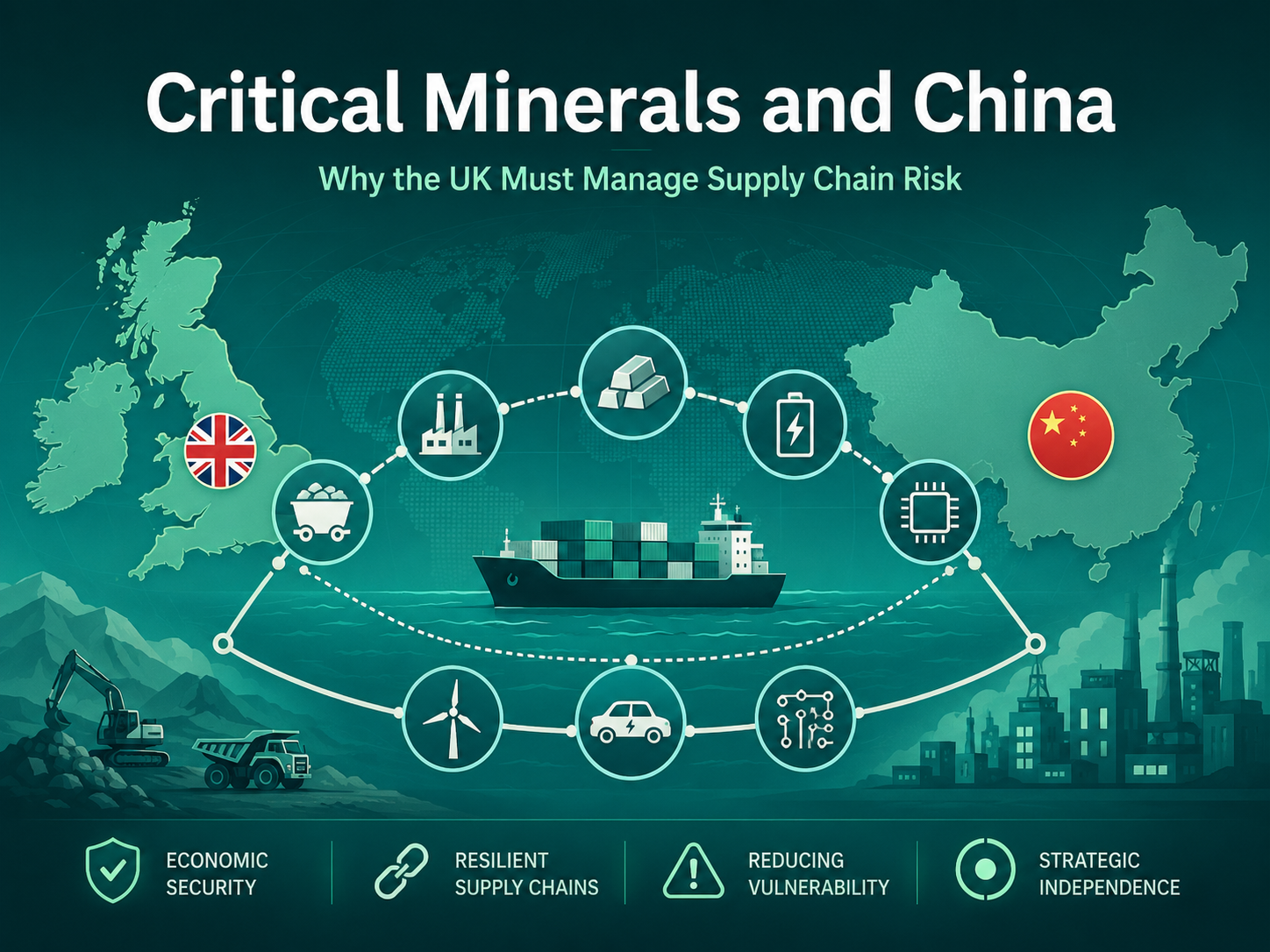
The United Kingdom cannot realistically sever its critical mineral links with China. A full decoupling strategy would likely damage the competitiveness of UK-linked mining companies, weaken the country’s position in global resource markets, and undermine commercial opportunities in financing, infrastructure, and offtake arrangements. The central argument of the Chatham House article is not that the UK should ignore its dependence on China, but that it should understand that dependence with far greater precision.
The UK’s challenge is not to eliminate China from its critical mineral supply chains. It is to identify where Chinese exposure exists, how deep it runs, which parts are commercially acceptable, and which parts create strategic vulnerabilities. In practical terms, the UK needs a policy of managed coexistence: continued engagement with China where necessary, combined with clearer limits on corporate governance risk, shared infrastructure risk, sensitive data exposure, and political coercion.
1. Critical Minerals Have Become a Question of Industrial Sovereignty
Critical minerals are no longer merely raw materials. Lithium, cobalt, nickel, graphite, rare earths, copper, tungsten, vanadium, and other strategic minerals now underpin electric vehicles, batteries, semiconductors, renewable energy systems, defence equipment, data centres, telecommunications infrastructure, and advanced manufacturing.
This has transformed critical minerals from a commodity issue into a matter of industrial sovereignty. The key question is no longer simply whether a country can buy minerals at competitive prices. The deeper question is whether it can maintain industrial capacity, technological independence, and national resilience when the upstream supply chain is concentrated in a strategic competitor.
The problem is not limited to mining. In many cases, the greatest vulnerability lies in processing, refining, intermediate products, magnets, chemicals, alloys, battery materials, and semi-manufactured components. A mineral may be mined outside China, but if it is refined, processed, or converted into usable industrial inputs in China, the effective supply-chain dependency remains China-centred.
This is the context in which the UK must assess its position. Unlike the United States, the UK does not have the same scale of mining capacity, industrial base, fiscal firepower, or strategic need to build a China-free critical minerals system from the ground up. Nor is the UK an East Asian manufacturing powerhouse like Japan, South Korea, or Taiwan, where electronics, semiconductors, batteries, and precision components create far more acute exposure to Chinese export controls.
For the UK, the question is therefore not whether it can copy the US model of decoupling. It cannot. The real question is how it can remain commercially engaged while preventing economic dependency from turning into strategic vulnerability.
2. The UK Is Not Only Dependent on China — It Also Benefits from China
The UK-China relationship in critical minerals is not a simple story of one-sided dependence. China is a source of risk, but it is also a major customer, investor, financier, infrastructure partner, and commercial counterparty for UK-linked mining companies.
Many large mining firms are registered or listed in the UK. These companies stand to benefit from the global race for minerals because they occupy important positions in the international mining industry. For some of these firms, China is not merely a marginal buyer; it is a dominant customer, sometimes accounting for a very large share of revenues.
This creates a structural dilemma. If the UK were to pursue a hard separation from China, it would not only reduce supply-chain exposure. It could also weaken the revenue base of UK-linked mining companies, reduce their access to capital, complicate major development projects, and diminish the UK’s influence in global resource markets.
China’s role is also embedded in ownership structures and project finance. Chinese investors have expanded dramatically across overseas mining assets over the past two decades. In some cases, Chinese capital, offtake agreements, operational cooperation, and infrastructure support are what make large mining projects commercially viable. This is particularly relevant for major copper, iron ore, bauxite, and other strategic resource projects.
The UK therefore faces a dual reality. China is a risk factor, but it is also part of the commercial architecture that supports global mining. A policy based purely on separation would fail to reflect this reality.
3. The UK’s Real Vulnerability Lies in Hidden Dependencies
A crucial insight of the article is that the UK’s exposure to China is not always visible in direct import statistics. The UK may not import large volumes of refined critical minerals directly from China in every case. But UK industries may still depend on semi-manufactured parts, components, chemicals, magnets, battery materials, alloys, or equipment from third countries whose own supply chains depend on Chinese processing.
This is the deeper vulnerability. A British company may appear to be buying from Europe, South Korea, Japan, Taiwan, or Southeast Asia. But if the upstream refining, processing, or intermediate production takes place in China, the dependency is still present. It is simply hidden several layers upstream.
This matters for risk management. It means that looking only at first-tier suppliers is insufficient. Companies and governments need to understand the second-tier, third-tier, and fourth-tier supply chain. They need to know where minerals are mined, where they are refined, where they are processed, where components are manufactured, which logistics routes are used, and who controls the data generated along the way.
In other words, the UK’s critical minerals risk is not just a trade issue. It is a supply-chain mapping issue. The problem is not merely “where does the UK buy from?” The better question is: who controls the processing, financing, infrastructure, data, and decision-making capacity behind the products the UK ultimately uses?
4. China Could Weaponize Supply Chains, but Full-Scale Disruption Would Also Hurt China
China has the capacity to weaponize parts of the critical minerals supply chain. Export controls on rare earths, gallium, germanium, graphite, and other strategic inputs have already shown how mineral supply can become a tool of geopolitical leverage.
However, the Chatham House article makes an important distinction: the possibility of weaponization does not mean that China will always pursue sustained, full-scale disruption. China’s economy remains deeply tied to export-led growth. If Beijing were to alienate major export markets too aggressively, it would also damage Chinese manufacturers, employment, foreign exchange earnings, investor confidence, and the broader credibility of China as a commercial partner.
This creates a form of mutual vulnerability. The UK and other Western economies depend on China for key inputs, but China also depends on export markets, commercial relationships, and the continued functioning of global supply chains. That does not eliminate the risk of coercion. But it does mean that the UK should avoid both complacency and panic.
The sensible policy response is not to assume that China will never restrict supply. Nor is it to assume that China will inevitably cut off everything. The appropriate response is to identify the precise scenarios in which China could restrict a specific mineral, component, technology, infrastructure route, or dataset — and then assess how that disruption would affect UK industry, consumers, and national resilience.
5. The UK’s 2025 Critical Minerals Strategy Is a Foundation, Not a Finished Framework
The UK’s 2025 critical minerals strategy provides a useful foundation. It sets out objectives around domestic production, recycling, supply diversification, strategic partnerships, and reduced dependence on any single country. These are sensible goals.
However, the Chatham House article argues that the strategy does not go far enough in addressing the geopolitical realities of China’s role in processing and supply-chain control. The issue is not simply whether the UK can produce more domestically or recycle more minerals. The deeper issue is how UK companies should engage with Chinese capital, Chinese infrastructure, Chinese customers, Chinese technology, and China-dependent third-country suppliers.
This is where the policy gap lies. The UK has a broad strategy, but it needs more operational guidance. Companies need to know what kinds of engagement with China are acceptable, what kinds require enhanced due diligence, and what kinds create unacceptable strategic exposure.
Without clearer guidance, private companies will continue to make decisions based mainly on commercial efficiency. That is rational from a corporate perspective, but it may lead to the accumulation of national vulnerabilities over time.
6. The Main Risks Are Corporate Governance, Shared Infrastructure, and Data
The article is especially valuable because it moves beyond the usual discussion of mineral supply volumes and focuses on three deeper sources of vulnerability: corporate governance, shared infrastructure, and data protection.
Corporate Governance Risk
Foreign investment in UK-linked mining companies is not inherently problematic. The UK should remain an open investment environment. However, Chinese shareholdings can become strategically sensitive if they allow Chinese entities to influence corporate governance, voting rights, board decisions, mineral flows, offtake agreements, or compliance with export controls.
The key question is not whether Chinese capital is present. The key question is whether Chinese capital can influence strategic decisions in ways that could compromise UK interests.
A practical policy response would not necessarily require banning Chinese investment. Instead, the UK could consider limiting voting rights, restricting board influence, scrutinizing offtake arrangements, or creating safeguards to prevent Chinese shareholders from directing mineral flows in line with Beijing’s political priorities.
Shared Infrastructure Risk
Mining projects often depend on shared infrastructure: railways, roads, ports, power systems, border facilities, and logistics corridors. In many resource-rich regions, particularly in Africa and parts of the Global South, China has financed or built critical transport infrastructure through the Belt and Road Initiative and related investment channels.
UK companies may rely on these routes to bring minerals to market. A blanket prohibition on using Chinese-linked infrastructure would be commercially unrealistic and could place UK firms at a disadvantage. But ignoring the risk would also be careless.
The better approach is to provide guidance. Companies need best-practice standards for using infrastructure that crosses geopolitical fault lines. These standards should cover alternative routes, contractual protections, data safeguards, contingency planning, political-risk assessment, and emergency access rights.
Data Protection Risk
The mining industry is becoming increasingly digital. Automation, sensors, satellite monitoring, border scanning, AI systems, logistics platforms, and remote operations generate large amounts of commercially sensitive data.
This data can include production volumes, ore quality, inventory levels, shipment routes, customer information, technical processes, and operational performance. Such information is commercially valuable and can also be strategically sensitive.
If Chinese technology is embedded in border scanning systems, logistics platforms, shared infrastructure, or mining operations, there is a risk that sensitive data could be exposed. This is not merely a cybersecurity issue. It is an economic security issue.
The UK should therefore treat mining data as part of the critical minerals security framework. Data governance, cloud storage, equipment certification, vendor risk management, and access controls should be integrated into critical minerals policy.
7. The UK Needs Managed Coexistence, Not Symbolic Decoupling
The most realistic strategy for the UK is managed coexistence. This means accepting that China will remain part of the global critical minerals ecosystem, while ensuring that engagement takes place within clear boundaries.
A credible UK framework should include five elements.
First, the UK should map its dependencies by mineral, process, company, component, and infrastructure route. It should not rely solely on import data.
Second, the UK should distinguish between commercial exposure and strategic vulnerability. Selling minerals to China may be commercially beneficial. Allowing Chinese entities to control mineral flows, sensitive data, or corporate decision-making is a different matter.
Third, the UK should issue clear guidance to companies on Chinese investment, shared infrastructure, data protection, and high-risk supply-chain arrangements.
Fourth, the UK should provide diplomatic cover for companies operating in politically complex environments. Private firms should not be left alone to manage geopolitical pressure from major powers.
Fifth, the UK should work through international forums, including the G20, to develop rules on responsible infrastructure, transparent mineral supply chains, data protection, and coercion-resistant trade practices.
This is not a soft approach. It is a disciplined approach. It recognizes that economic security is not achieved by slogans, but by identifying control points and managing them.
8. Implications for Japan
The article is about the UK, but its implications for Japan are significant. Japan’s exposure is in many ways more serious. Japan has a broad and sophisticated manufacturing base, including automobiles, batteries, semiconductors, precision machinery, electronics, robotics, defence equipment, and advanced materials. These sectors are deeply dependent on stable access to critical minerals and processed inputs.
For Japan, the case for diversification is stronger than it is for the UK. Japan cannot simply accept deep exposure to Chinese processing capacity, especially in areas linked to semiconductors, batteries, rare earth magnets, defence systems, and industrial machinery. Stockpiling, recycling, substitute materials, long-term offtake agreements, overseas resource diplomacy, and allied supply-chain coordination are all essential.
However, Japan can still learn from the UK debate. The most important lesson is that dependency should not be measured only by direct imports from China. Japanese companies may source components from third countries while still depending indirectly on Chinese refining, processing, chemicals, magnets, or intermediate materials.
Japanese companies and financial institutions therefore need to look beyond first-tier suppliers. They should examine where upstream processing occurs, who owns the infrastructure, who controls the logistics data, who finances the project, who holds offtake rights, and who can influence corporate decisions in a crisis.
For banks, trading houses, manufacturers, and policy finance institutions, this changes the nature of due diligence. Critical minerals risk is not only about commodity price volatility. It is about supply-chain control, political leverage, data exposure, and the ability to continue operations under geopolitical stress.
9. Practical Risk-Management Checklist
| Risk Area | Key Question |
|---|---|
| Mineral exposure | Which minerals are essential to business continuity? |
| Processing exposure | Where are the minerals refined, processed, and converted into usable inputs? |
| Component exposure | Are third-country suppliers dependent on Chinese intermediate materials? |
| Substitution risk | Are alternative suppliers available, and how long would switching take? |
| Governance risk | Can Chinese shareholders, joint-venture partners, or offtakers influence corporate decisions? |
| Infrastructure risk | Do logistics routes depend on Chinese-built or Chinese-controlled railways, ports, roads, or scanning systems? |
| Data risk | Could production, quality, inventory, shipment, or customer data be accessed by foreign entities? |
| Contract risk | Do contracts include provisions for export controls, sanctions, force majeure, and political disruption? |
| Financial risk | How would supply disruption affect revenue, working capital, inventory, covenants, credit ratings, and refinancing? |
| Policy risk | Is the company aligned with national security expectations and government guidance? |
Conclusion: The Future of Critical Minerals Policy Is Dependency Intelligence
The Chatham House article’s central message is that critical minerals policy should not be reduced to a binary choice between dependence and decoupling. The real task is to understand dependency.
The UK cannot fully cut China out of its critical minerals ecosystem. China is too deeply embedded in processing, infrastructure, finance, offtake markets, and global mining networks. But this does not mean the UK should passively accept vulnerability. It means the UK must develop a more sophisticated form of economic security: one based on visibility, governance, data protection, corporate guidance, and diplomatic coordination.
For Japan and other advanced economies, the lesson is even broader. The most dangerous dependencies are often not visible at the surface. They are hidden in intermediate goods, refining capacity, logistics corridors, shareholder rights, digital systems, and contractual obligations.
The next phase of economic security will not be defined simply by who owns the mine. It will be defined by who processes the mineral, who finances the project, who controls the infrastructure, who holds the data, and who can influence corporate decisions under pressure.
In the age of critical minerals, resilience does not mean isolation. It means knowing precisely where one is exposed — and having the institutional capacity to manage that exposure before it becomes coercion.