- Iran’s Rising Strategic Status in a Fragmenting World Order
- 1. Iran’s status has risen — not through admiration, but through indispensability
- 2. The American model of coercive resolution does not work cleanly in Hormuz
- 3. Iran is not isolated: China, Russia, and Pakistan matter
- 4. Why Japan and Europe cannot imitate Iran
- 5. The Hormuz crisis is not only an American failure; it is also an allied anxiety
- 6. Iran has not “won”; it has proven that it cannot be excluded
- 7. Implications for Japan
- Conclusion: The return of power, and the limits of power
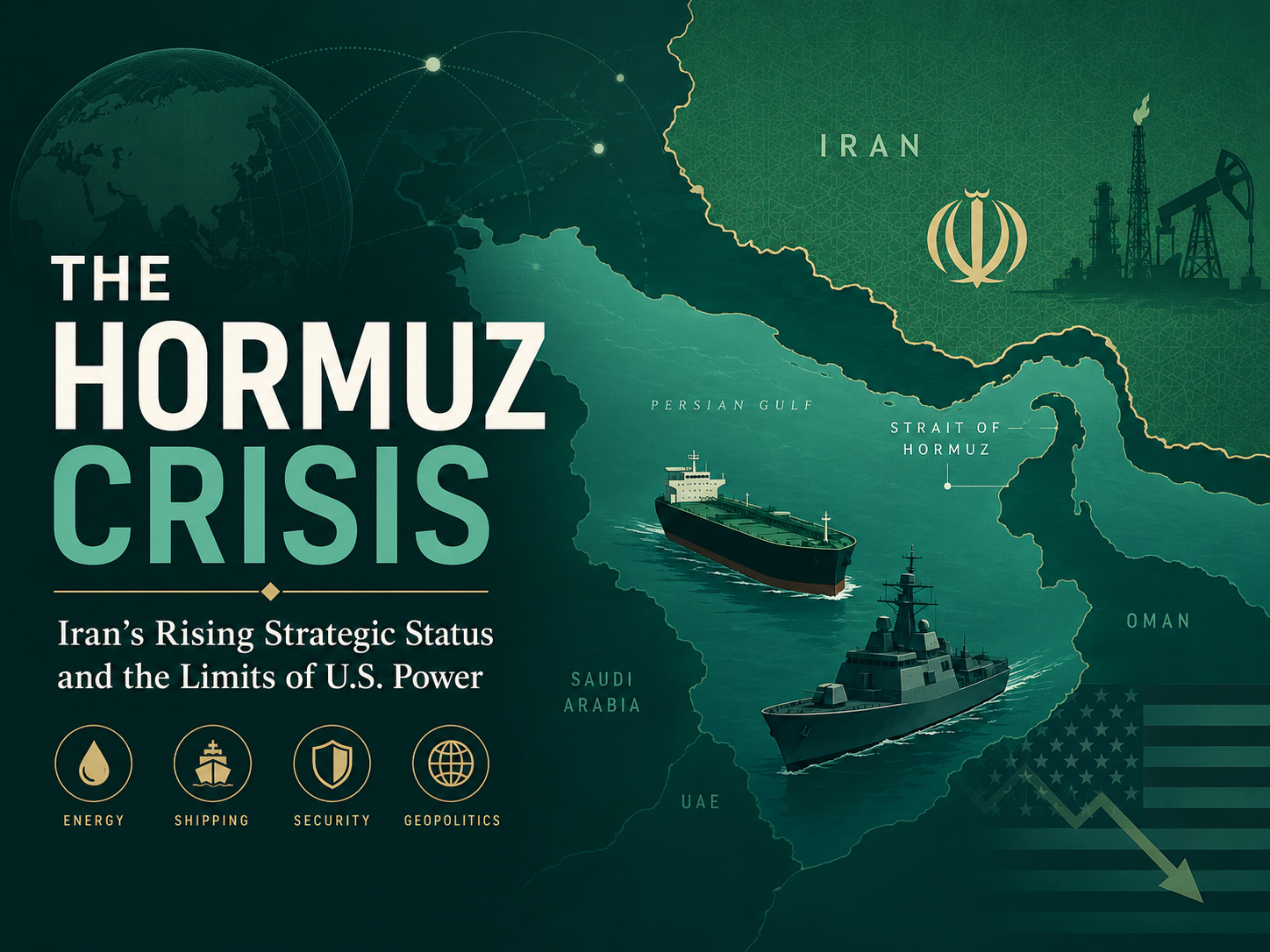
Iran’s Rising Strategic Status in a Fragmenting World Order
The central lesson of the latest Hormuz crisis is not that Iran has “defeated” the United States in any simple military sense. The deeper point is that the United States can no longer redesign the Middle Eastern order through force alone, and no serious settlement of Gulf security, maritime passage, or energy stability can be built while excluding Iran.
Britain’s decision to deploy the air-defence destroyer HMS Dragon to the Middle East is a symbolic event in this wider shift. According to Reuters, the deployment is intended to prepare for a possible multinational mission to protect shipping through the Strait of Hormuz once conditions allow. The mission would be jointly led by Britain and France, rather than by the United States alone. This matters because it suggests that the crisis has moved from a phase of direct military confrontation to one of internationalized passage management.
For Washington, this is not a clean victory. It is closer to an implicit admission that American military power alone cannot restore confidence in one of the world’s most important maritime chokepoints. To reopen Hormuz in a way that shipowners, insurers, energy companies, and import-dependent economies can trust, missiles and aircraft carriers are not enough. What is needed is Iranian acquiescence, Gulf Arab acceptance, insurance-market confidence, and the political participation of allies.
1. Iran’s status has risen — not through admiration, but through indispensability
Iran’s international standing has indeed improved in one important sense. But this is not the kind of status enjoyed by countries that are trusted, investable, institutionally respected, or admired for their soft power. Iran has gained something different: the strategic status of a state that controls pressure points the global economy cannot ignore.
The Strait of Hormuz is not merely a narrow waterway in the Middle East. It is one of the central arteries of the global energy system. In 2024, roughly 20 million barrels per day of oil passed through the Strait, equivalent to about one-fifth of global petroleum liquids consumption. Around one-fifth of global LNG trade also passed through the same chokepoint, much of it from Qatar.
These numbers reveal Iran’s structural advantage. Iran does not need to defeat the United States militarily in order to impose costs on Washington and its allies. It only needs to raise uncertainty around Hormuz. Once it does, the effects spread immediately into oil prices, LNG prices, shipping costs, war-risk insurance, inflation expectations, exchange rates, and corporate earnings.
In that sense, Iran has not proven that it is stronger than the United States. It has proven something more subtle: that the United States cannot pressure Iran without also exposing the global economy to severe collateral risk.
That is a form of power. It is not the power of trust. It is the power of leverage.
2. The American model of coercive resolution does not work cleanly in Hormuz
The Trump administration likely began from the assumption that overwhelming pressure could force Iran into submission. But Hormuz is not an ordinary battlefield. In Hormuz, the crucial issue is not simply who has superior firepower. The issue is whether ships will sail, insurers will cover them, energy firms will contract cargoes, and importing countries will accept the risk.
This is why the crisis could not be resolved simply by declaring that the U.S. Navy would “keep the Strait open.” From Tehran’s perspective, a U.S.-led maritime mission does not look like neutral protection of international commerce. It looks like hostile control over Iran’s strategic perimeter.
That is why Britain and France matter. By placing London and Paris at the front of a multinational framework, the mission can be presented less as an American operation against Iran and more as an international effort to restore commercial passage. HMS Dragon is therefore not important only as a warship. It is also a political instrument designed to reduce the American signature of the operation and reassure shipping and insurance markets.
This distinction is critical. The United States can project force. But restoring passage through Hormuz requires the reconstruction of confidence. Confidence cannot be bombed into existence.
3. Iran is not isolated: China, Russia, and Pakistan matter
Iran’s stronger position is not based solely on geography. It is also supported by a wider geopolitical environment in which China, Russia, and Pakistan each play a role.
China is Iran’s most important strategic rear base. Beijing is unlikely to fight the United States on Iran’s behalf. It avoids formal defence commitments and tends to calibrate its support carefully. But China benefits from Iran’s ability to complicate American strategy in the Middle East. Iran helps demonstrate to Gulf states that U.S. power is not absolute. At the same time, Iran benefits from China’s economic weight, diplomatic cover, and role as a counterweight to Western pressure.
This is not a classic alliance. It is a relationship of mutual utility. China uses Iran as a strategic card. Iran uses China to widen its room for manoeuvre.
Russia plays a similar role. For Moscow, Iran is useful because it can tie down American attention in the Middle East at a time when Russia remains locked in confrontation with the West over Ukraine. Russia may not be able to fully protect Iran, but it can help create a broader anti-Western diplomatic space in which Tehran has more options.
Pakistan is especially important in the current crisis. Islamabad has emerged as a potential intermediary between Washington and Tehran. This gives Iran a valuable diplomatic channel. It allows Tehran to avoid appearing to submit directly to American pressure while still engaging in negotiations through a regional actor. Domestically, Iran can frame this as regional diplomacy rather than capitulation. Internationally, it can present itself as a state capable of negotiation rather than a reckless spoiler.
This is one of Iran’s more effective moves: combining military resistance with diplomatic flexibility.
4. Why Japan and Europe cannot imitate Iran
Your point is important: Japan and Europe cannot behave like Iran. This is not because they lack courage. It is because their national structures are fundamentally different.
Japan and Europe are deeply embedded in the U.S.-led security, financial, maritime, and technological order. They rely on American security guarantees, dollar markets, global insurance systems, supply chains, shipping lanes, and investor confidence. If Japan were to confront the United States militarily or strategically in the way Iran has done, the consequences would spread immediately to the yen, Japanese government bonds, energy imports, corporate finance, and regional deterrence.
Europe faces a similar constraint through NATO, dollar finance, U.S. technology, and transatlantic security dependence.
Iran is different. Decades of sanctions have already pushed it partly outside the normal international financial system. It has lost many of the benefits that Japan and Europe still need to preserve. That gives Iran a dangerous form of freedom. It can say, in effect: “If you impose more sanctions, we will absorb them; if you apply more pressure, we will raise the cost through Hormuz.”
This is both strength and weakness. Iran can resist because it has already been excluded. Japan and Europe cannot copy Iran because they have too much to lose.
In one sentence: Japan and Europe are constrained by their integration into the system; Iran gains leverage from being partially outside it.
5. The Hormuz crisis is not only an American failure; it is also an allied anxiety
Britain’s deployment of HMS Dragon should not be read simply as support for Washington. It is also a sign that allies do not fully trust the United States to manage the crisis alone.
Britain and France understand that an unmanaged U.S.-Iran confrontation could damage global shipping, energy markets, insurance markets, and European economic stability. Their objective is not merely to join an American war. It is to pull an American-led crisis back into an internationally managed framework.
This reveals a subtle change in alliance politics. U.S. allies still need American power. But they are increasingly aware that American decisions can also create risks that allies must then help contain.
In the old order, Washington led, allies followed, and adversaries were expected to yield. In the emerging order, Washington still leads in military capacity, but allies increasingly seek to moderate, internationalize, and manage the consequences of American action.
That is a profound change.
6. Iran has not “won”; it has proven that it cannot be excluded
Did Iran win? The answer should be cautious.
Iran has not escaped economic pressure. Its economy remains burdened by sanctions, financial isolation, and domestic strain. The more it uses Hormuz as leverage, the more it alarms Asian and European energy importers. In terms of long-term investment, financial credibility, and commercial trust, Iran’s position has not improved significantly.
But Iran has achieved something strategically important: it has demonstrated that any Middle Eastern order built without Iran is unstable.
The United States could apply pressure, but Iran did not collapse. Maritime passage could not be fully normalized without some form of Iranian acceptance or restraint. China, Russia, Pakistan, Qatar, and other regional actors all became relevant channels. Even Britain and France moved toward a multinational passage framework rather than leaving the issue solely to Washington.
This is a major strategic result for Tehran.
Iran has not achieved victory in the conventional sense. But it has avoided defeat. In international politics, for a state under overwhelming pressure, avoiding defeat can itself raise status.
7. Implications for Japan
For Japan, the implications are clear and uncomfortable.
Japan should not imitate Iran. It cannot, and it should not. But Japan also cannot assume that American power alone will stabilize the Middle East or protect Japan’s energy security. The Hormuz crisis demonstrates that U.S. action can be both a source of protection and a source of systemic risk.
Japan therefore needs what might be called quiet strategic autonomy. This does not mean anti-Americanism. Nor does it mean abandoning the alliance. It means developing independent diplomatic, energy, financial, and maritime risk-management capacity within the alliance framework.
First, Japan should preserve dialogue channels with Iran. Japan has historically maintained a relatively constructive relationship with Tehran, and this diplomatic asset should not be wasted.
Second, Japan should deepen relations with Qatar, Oman, the UAE, Saudi Arabia, and Pakistan. In a Hormuz crisis, regional intermediaries may matter as much as Washington.
Third, Japan should stop viewing Hormuz risk only through oil prices. The real risk map includes LNG, war-risk insurance, shipping premiums, tanker availability, petrochemical feedstocks, electricity prices, inflation, and currency pressure.
Fourth, Japanese companies and financial institutions should treat Hormuz not as a temporary geopolitical headline but as a structural supply-chain and credit-risk factor. The key question is not simply whether the Strait is open or closed. The real question is: whose ships can pass, under whose guarantee, with what insurance, at what cost, and to which destination?
Fifth, Japan should consider how to support multinational maritime stability through finance, insurance, logistics, diplomacy, humanitarian assistance, and energy coordination — not only through military participation.
Conclusion: The return of power, and the limits of power
The Hormuz crisis is a warning that the unipolar moment is fading.
Iran has not become beloved. It has not become trusted. It has not become economically secure. But it has become impossible to ignore.
The United States remains extraordinarily powerful, but it could not simply impose a new order by force. Britain and France are stepping in not only to support Washington, but to internationalize and contain the risks created by the crisis. China and Russia are watching the limits of American power. Pakistan and Qatar are gaining value as intermediaries. Japan and Europe are discovering once again that their prosperity can be shaken by decisions made far beyond their own borders.
The essence of the crisis is not that Hormuz temporarily became dangerous. The deeper point is that the old pattern — America commands, allies follow, adversaries submit — no longer functions as cleanly as before.
Iran has not become a great power in the conventional sense. It is not wealthy. It is not broadly trusted. It is not institutionally admired. But it controls leverage. It can impose costs. It can force others to negotiate. In today’s world, that is a form of status.
The lesson for Japan is not to resist like Iran. The lesson is to stop assuming that American power alone can guarantee stability. Japan needs a more layered strategy: cooperate with the United States, maintain dialogue with Iran, deepen ties with Gulf states, coordinate with Europe, and manage energy, insurance, shipping, finance, and inflation as one integrated national-security problem.
The Hormuz crisis is not a story of simple winners and losers. It is a story about a world in which power has returned, but power alone can no longer create order.