- Executive Summary
- 1. The Accident: A Gas Explosion with Rapidly Rising Casualties
- 2. Why Shanxi Matters: The Heartland of China’s Coal System
- 3. Safety Regulation Was Already Being Tightened
- 4. China’s Coal Mine Safety Has Improved, but Tail Risks Remain
- 5. Economic and Market Implications: Limited Direct Impact, Potential Secondary Effects
- 6. The Structural Contradictions Revealed by the Accident
- 7. Practical Implications for Risk Analysis
- Conclusion
Executive Summary
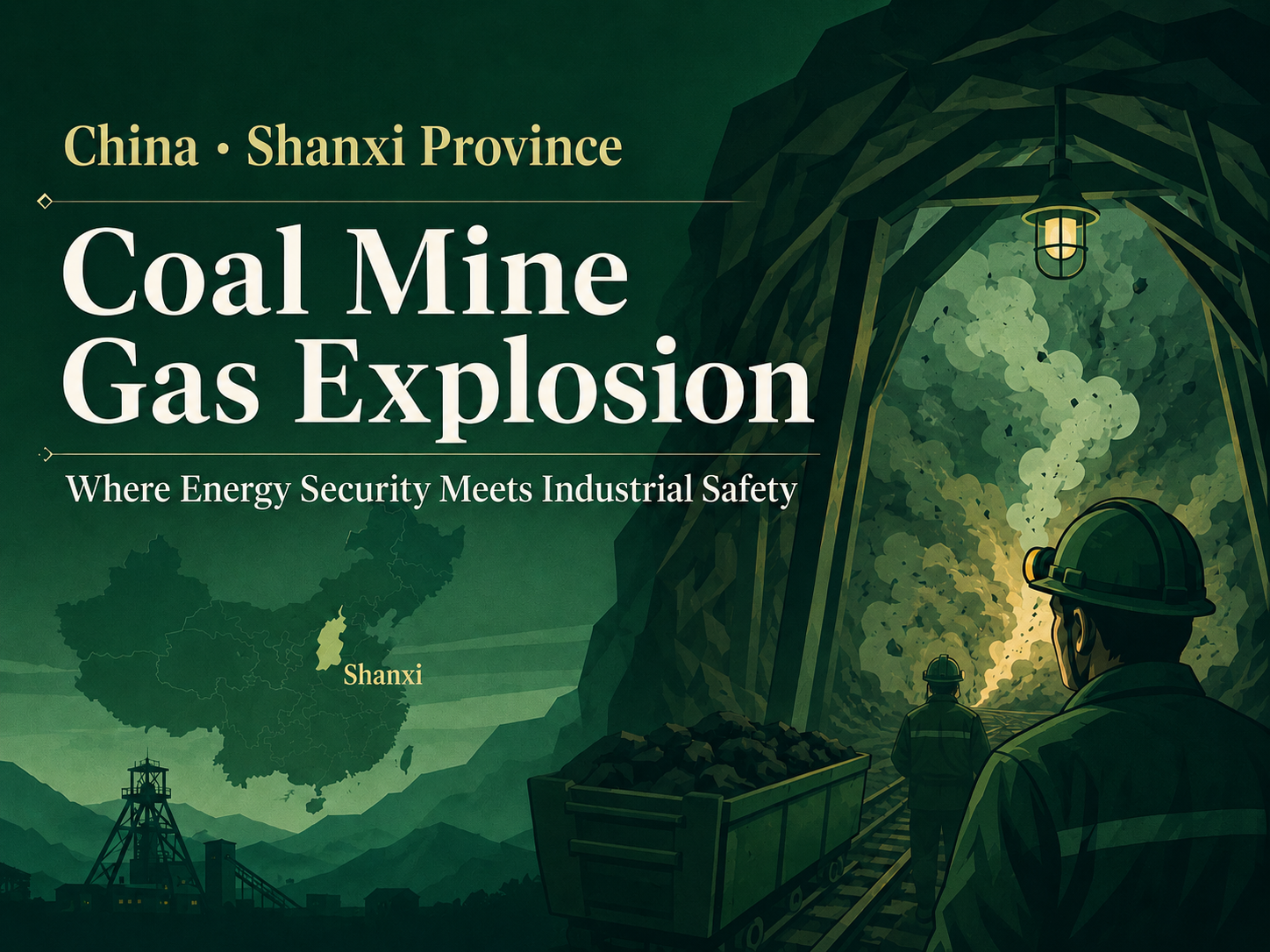
The gas explosion at the Liushenyu coal mine in Shanxi Province should not be viewed merely as an industrial accident. It is a revealing event that exposes three deeper structural issues in China: continued dependence on coal, the tension between production pressure and workplace safety, and the gap between central regulation and local implementation.
The explosion occurred on the evening of May 22, 2026, at the Liushenyu coal mine in Qinyuan County, Changzhi, Shanxi Province. According to state media reports cited by AFP, 247 workers were underground at the time of the accident. At least 90 people have been confirmed dead, while 9 remain missing. The death toll rose sharply from the initial reports, which had put the number of confirmed fatalities far lower.
The core issue is not simply that a mine exploded. The deeper issue is that China’s energy system still relies heavily on coal, even as the country pushes aggressively into renewable energy. Coal remains indispensable for electricity generation, steelmaking, chemicals, heating, and industrial stability. Shanxi Province is one of the most important coal-producing regions in China. Therefore, a disaster of this scale in Shanxi is not just a local accident. It is a signal about the hidden costs of China’s energy security model.
1. The Accident: A Gas Explosion with Rapidly Rising Casualties
The explosion took place at around 7:29 p.m. on May 22 at the Liushenyu coal mine. The mine reportedly had 247 workers underground at the time. Most were rescued by the following morning, but the confirmed death toll later surged to at least 90.
This sharp increase in fatalities is important. In underground coal mine accidents, the immediate blast is only one source of danger. A methane explosion can trigger fires, destroy ventilation systems, release carbon monoxide, block escape routes, and create oxygen-deficient conditions. Initial reports also indicated that carbon monoxide levels underground had exceeded safety limits.
In practical terms, the accident was likely made worse not only by the explosion itself, but also by the post-blast underground environment. Toxic gas, poor visibility, damaged tunnels, and limited access can make rescue and confirmation operations extremely difficult. This helps explain why the casualty count may have increased so sharply after the initial reports.
The eventual investigation will likely focus on the following points.
| Area | Key Questions |
|---|---|
| Gas management | Were methane levels properly monitored? Was ventilation sufficient? |
| Warning systems | Did gas and carbon monoxide sensors issue alarms before or after the explosion? |
| Ignition source | Did electrical equipment, friction, sparks, or unsafe procedures trigger the blast? |
| Evacuation | Were workers ordered to evacuate quickly enough? Were escape routes usable? |
| Company responsibility | Had prior safety violations been identified? Were corrective measures implemented? |
| Local supervision | Did regulators inspect the mine effectively? Was production pressure prioritized over safety? |
2. Why Shanxi Matters: The Heartland of China’s Coal System
Shanxi Province is not an ordinary mining region. It is one of the pillars of China’s coal supply system. China produces more coal than any other country in the world, and Shanxi has long been among its most important coal-producing provinces.
This matters because coal is still deeply embedded in China’s economic structure. It supports power generation, steel production, chemical manufacturing, heating, and local government revenues. Even with rapid expansion in solar, wind, nuclear, and hydropower, coal remains the stabilizing fuel in China’s energy system.
In this sense, Shanxi is not just a coal-producing province. It is part of the infrastructure of Chinese economic stability. A major accident there has implications beyond workplace safety. It touches energy security, industrial continuity, local finance, and central-local governance.
The key point is this: China’s coal system is both a source of stability and a source of systemic risk.
3. Safety Regulation Was Already Being Tightened
The timing of the accident is especially significant because China had already been strengthening coal mine safety regulation. Beijing has repeatedly emphasized the need to prevent major and catastrophic workplace accidents. Regulators have also pointed to recurring problems such as weak corporate safety responsibility, inadequate risk identification, poor hidden-danger inspections, and insufficient local supervision.
This reveals a familiar governance problem. At the central level, the message is clear: safety must come first. At the local level, however, the incentives are more complicated. Local governments must protect employment, tax revenue, industrial output, and energy supply. Coal companies want to avoid costly shutdowns. Mine managers may face pressure to maintain production even when safety conditions are deteriorating.
The result can be a dangerous gap between policy and practice.
Central government says: strengthen safety.
Local government says: maintain production and employment.
Coal companies say: avoid shutdowns and preserve cash flow.
Mine sites may then continue operating despite warning signs.
This is the structural background behind many large industrial accidents. Formal rules may exist, but the decisive issue is whether those rules are enforced at the point of production.
4. China’s Coal Mine Safety Has Improved, but Tail Risks Remain
China’s coal mine safety record has improved significantly compared with the early 2000s. Fatalities and accident rates have declined over the long term. Larger mines, consolidation, stricter regulation, better monitoring systems, and more centralized oversight have all contributed to that improvement.
But lower average accident rates do not mean that catastrophic risk has disappeared. Coal mining has a particular risk profile. The frequency of accidents may fall, but when a major gas explosion occurs, the loss of life can still be enormous.
This distinction is important for risk management. A system can show improving safety statistics while still retaining severe tail risk. In other words, the average trend may look better, but the extreme scenario remains dangerous.
The Shanxi accident is a reminder that in heavy industry, especially underground mining, a single failure in gas monitoring, ventilation, evacuation, or operational discipline can overwhelm years of incremental safety improvement.
5. Economic and Market Implications: Limited Direct Impact, Potential Secondary Effects
The direct impact on China’s national coal supply is likely to be limited if the disruption remains confined to one mine. China’s coal output is enormous, and no single mine is likely to determine national supply conditions.
The more important question is what happens next. If the central government orders broad safety inspections across Shanxi and other coal-producing regions, some mines may face temporary shutdowns, production restrictions, or stricter compliance requirements. That could create localized supply tightness or upward pressure on coal prices.
The possible transmission channels are as follows.
| Transmission Channel | Potential Impact |
|---|---|
| Safety inspections | Temporary shutdowns or slower production at high-risk mines |
| Local regulatory tightening | More cautious permitting and operating approvals |
| Coal prices | Local or regional price pressure if supply is constrained |
| Power generation | Higher fuel costs for coal-fired power producers |
| Steel and chemicals | Higher input costs for coal-intensive industries |
| Credit risk | Pressure on coal companies with weak safety records |
| Political risk | Stronger central intervention in local industrial governance |
For financial and corporate risk analysis, the key is not the output of this single mine. The key is whether the accident triggers a broader regulatory response.
6. The Structural Contradictions Revealed by the Accident
The accident reveals four major contradictions in China’s economy and governance.
First, the contradiction between decarbonization and coal dependence.
China is a global leader in renewable energy deployment, but it remains the world’s largest coal producer and consumer. Renewable capacity is expanding rapidly, but electricity demand and industrial demand are also growing. Coal therefore continues to function as a stabilizer in the power system.
Second, the contradiction between central rules and local implementation.
Beijing can issue strict safety directives. But enforcement happens locally. Local officials must balance safety with employment, tax revenue, production targets, and energy supply. This creates room for selective enforcement or delayed corrective action.
Third, the contradiction between stable supply and safety investment.
Ventilation systems, methane drainage, gas monitoring, explosion-proof equipment, emergency training, and evacuation systems all require investment. When margins are under pressure, companies may treat safety costs as deferrable. That is precisely where major accident risk accumulates.
Fourth, the contradiction between improving statistics and catastrophic loss potential.
Accident rates may decline over time, but underground mining remains capable of producing mass-casualty events. A low-frequency, high-severity event can still generate political, financial, and social consequences far beyond the mine itself.
7. Practical Implications for Risk Analysis
This incident should be read as a risk signal in three dimensions.
1. China’s energy security remains coal-centered.
Despite massive renewable investment, coal remains the backbone of China’s energy stability. Therefore, coal mine safety incidents are not marginal events. They can affect electricity, industrial production, local governance, and commodity sentiment.
2. Shanxi’s regulatory response matters more than the individual mine.
The most important next indicator is whether Shanxi launches a broad safety campaign. If inspections expand across major coal-producing regions, the impact could extend to coal prices, power costs, steel margins, and chemical producers.
3. Corporate safety records may become a credit risk factor.
The reported detention of company officials suggests that responsibility may be pursued not only administratively but also legally and politically. Coal companies with repeated safety violations could face higher scrutiny from regulators, banks, insurers, and investors.
Conclusion
The Shanxi coal mine gas explosion is not an isolated industrial accident. It is a window into the structural tensions of China’s energy model.
China wants cleaner energy, but it still needs coal. Beijing wants stronger safety regulation, but local governments need production, employment, and revenue. Coal companies are required to invest in safety, but they also face pressure to maintain output and profitability. These tensions do not disappear simply because regulation becomes stricter.
The central lesson is clear: coal remains both a stabilizing pillar of the Chinese economy and one of its most persistent sources of industrial, political, and governance risk.
For analysts, the most important questions now are not limited to the technical cause of the explosion. The key questions are: how far safety inspections will spread, whether additional mines will be suspended, how aggressively local officials and company executives will be held accountable, whether coal prices react, and whether Beijing prioritizes safety enforcement over uninterrupted coal supply.