- The War No Longer Stops at Ukraine’s Borders
- The Romania Incident Represents a Crisis Below Article 5
- Kaliningrad Is Both Russia’s Sword and Its Vulnerable Point
- NATO’s Eastern Flank Is Becoming the Front Line of Low-Intensity Conflict
- The Main Danger Is Not Intentional War, but the Politicization of Accidents
- Putin’s Objective Is to Probe NATO’s Thresholds
- Europe Is Not Entering a New Cold War, but an Ambiguous Hot War
- Conclusion: Full-Scale War Is Not the Base Case, but the Risk of Direct Contact Is Rising
The War No Longer Stops at Ukraine’s Borders
The Russian drone incident in eastern Romania, where a drone reportedly struck an apartment building in Galați and injured civilians, should not be treated merely as an isolated accident. Since Russia’s full-scale invasion of Ukraine in February 2022, drones, missile debris, and airspace violations have repeatedly affected NATO territory. What makes this case more significant is that the incident involved damage to a residential building and civilian injuries inside a NATO member state.
This does not mean that Russia and NATO are on the verge of immediate all-out war. The more precise assessment is that the outer edge of the Ukraine war is gradually bleeding into NATO territory. Russia appears to be operating in the grey zone between accident and intimidation, testing NATO’s reaction threshold, air-defense readiness, and political cohesion.
The nature of war is changing. War is no longer defined only by tanks crossing borders or formal declarations of hostilities. Low-flying drones, GPS jamming, cyberattacks, sabotage, disinformation, airspace violations, and pressure on civilian infrastructure have become part of the modern conflict environment. These lower-intensity actions, when repeated, gradually alter the security landscape. Europe is not yet in a formal Russia-NATO war, but it is moving deeper into a zone of persistent confrontation.
The Romania Incident Represents a Crisis Below Article 5
The drone incident in Romania is highly difficult for NATO to handle. If Russia had clearly and deliberately attacked Romania, the issue of NATO Article 5—collective defense—would inevitably arise. But Russia has preserved ambiguity. Moscow has questioned the attribution of the drone, while Romanian officials have also referred to the possibility that the drone may have changed course after being intercepted over Ukrainian airspace. Romania has not treated the incident as a direct Russian attack on the Romanian state.
This ambiguity is precisely the strategic problem. Russia is not necessarily trying to trigger Article 5 directly. Instead, it is raising the level of risk near NATO borders while preserving plausible deniability. In other words, this is a crisis that exists in the space between war and peace.
For NATO, the difficult question is where to draw the line. Is falling debris an accident? Is an airspace violation a warning? Is a drone strike on an apartment building an attack? Does civilian injury change the legal and political nature of the incident? If civilians are killed in the future, would that require a different NATO response? The lack of clear answers gives Russia strategic room to maneuver.
Kaliningrad Is Both Russia’s Sword and Its Vulnerable Point
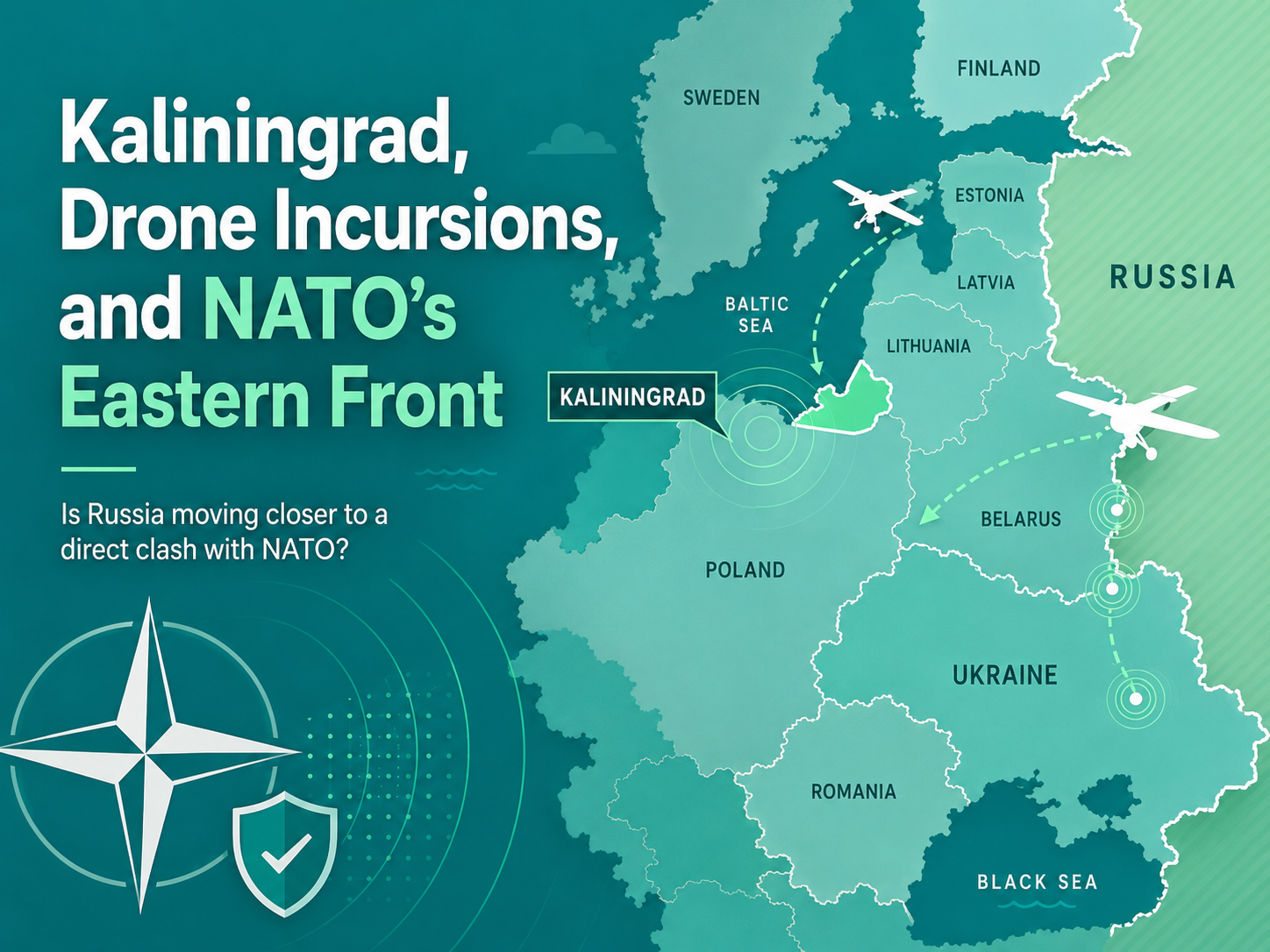
Against this backdrop, Kaliningrad has become even more important. Kaliningrad is a Russian exclave located between Poland and Lithuania, both NATO members, and sits on the Baltic Sea. It is separated from mainland Russia, but this geographic isolation gives it immense military and psychological significance.
For President Vladimir Putin, Kaliningrad is not merely a piece of Russian territory. First, it is a forward military fortress embedded inside NATO’s strategic space. With the Baltic Fleet, air-defense systems, missiles, electronic warfare capabilities, and anti-access/area-denial assets, Russia can use Kaliningrad to pressure the Baltic Sea region, Poland, Lithuania, Germany, and the Nordic countries. It is a base from which Russia can complicate NATO’s freedom of movement.
Second, Kaliningrad carries historical symbolism. Formerly Königsberg, part of German East Prussia, the region became Soviet territory after the Second World War. For the Putin regime, which places the memory of Soviet victory in the “Great Patriotic War” at the core of Russian national legitimacy, Kaliningrad is not just a military asset. It is also a symbol of Russia’s postwar status and victory narrative. Any pressure on Kaliningrad can therefore be framed domestically as an attack on Russia’s historical rights and national dignity.
Third, Kaliningrad is also a vulnerability. It is surrounded by NATO countries and depends on constrained land and sea routes for supply. Its isolation makes it useful as a forward military platform, but also exposes it to pressure in a crisis. For Russia, Kaliningrad is both a sword pointed at NATO and a hostage held inside NATO’s strategic environment.
This duality explains why Putin reacts so strongly to any suggestion that Kaliningrad could be targeted or neutralized. His warnings are not merely rhetorical. They are intended to establish Kaliningrad as a red line, both for NATO and for the Russian domestic audience. To defend Kaliningrad is to show that Russia has not been pushed out of Europe.
NATO’s Eastern Flank Is Becoming the Front Line of Low-Intensity Conflict
The most dangerous areas in the coming period are likely to be Romania, Poland, the Baltic states, the Black Sea, the Baltic Sea, and the Kaliningrad region. These are places where Russia and NATO do not need to be in a declared war for military contact to become more frequent.
Romania is exposed because it sits across the Danube from Ukraine’s river ports, including Reni and Izmail. If Russia intensifies attacks on Ukraine’s port and logistics infrastructure, the effects can easily spill over into Romanian territory. Poland is critical because it serves as one of the main logistical hubs for Western support to Ukraine. The Baltic states are vulnerable because of their geography, located near Russia, Belarus, and Kaliningrad.
The Suwałki Gap is especially important. This narrow corridor between Poland and Lithuania connects the Baltic states to the rest of NATO by land. At the same time, it lies between Kaliningrad and Belarus. In any Russia-NATO crisis, the Suwałki Gap would immediately become one of the most sensitive points in Europe.
That said, a large-scale Russian invasion of a NATO member state is not the most likely near-term scenario. The costs for Russia would be enormous. The greater danger lies below the threshold of full-scale war: drones, electronic warfare, cyberattacks, sabotage, airspace violations, maritime incidents, and psychological pressure. These are the instruments Russia can use to pressure NATO without formally crossing the line into open war.
The Main Danger Is Not Intentional War, but the Politicization of Accidents
When assessing the risk of a Russia-NATO clash, the most realistic scenario is not a deliberate Russian decision to launch a conventional attack on NATO. The more realistic danger is a chain reaction triggered by accident, miscalculation, interception, retaliation, and domestic political pressure.
Consider a plausible sequence. Russia launches a large-scale attack on western Ukraine or the Danube port region. Some drones are intercepted by Ukrainian air defenses, while others deviate toward Romanian or Polish territory. NATO aircraft or air-defense units are scrambled. A drone is shot down. Russia claims that NATO attacked a Russian asset. Alternatively, a drone causes civilian deaths inside NATO territory. Domestic opinion in Romania, Poland, or the Baltic states hardens. NATO convenes emergency consultations under Article 4. Additional forces are deployed. Rules of engagement are revised.
At that point, neither side may want a full-scale war, but the crisis begins to generate its own momentum. Russia cannot easily step back without appearing weak. NATO cannot easily step back without damaging the credibility of deterrence. This is how local incidents can become strategic crises.
In international politics, the most dangerous events are not always planned attacks. They are often ambiguous incidents that force governments to respond under pressure from public opinion, alliance commitments, military credibility, and media scrutiny. Eastern Europe is increasingly entering such a danger zone.
Putin’s Objective Is to Probe NATO’s Thresholds
For Putin, a full-scale war with NATO is not a rational objective. But probing NATO’s thresholds is rational. How far can Russia go before NATO treats an incident as more than an accident? What level of airspace violation leads to Article 4 consultations? What level of damage triggers forward deployment? What level of civilian casualty produces a serious Article 5 debate? Where are the differences between the United States and Europe? How unified is NATO in practice?
Russia appears to be testing these questions through repeated military and hybrid actions. Drones enter or approach NATO territory. Moscow denies responsibility or clouds attribution. European governments condemn the incident. NATO reaffirms deterrence. Then the pattern repeats.
The key feature is plausible deniability. Russia questions the identity of drones, points to Ukrainian interception, suggests Ukrainian responsibility, or calls for “objective investigation.” This enables Moscow to create pressure while making it difficult for NATO to respond through collective-defense mechanisms.
Europe Is Not Entering a New Cold War, but an Ambiguous Hot War
Calling the current situation a “new Cold War” is insufficient. The original Cold War involved clear spheres of influence, structured nuclear deterrence, and relatively stable rules of confrontation. Today’s environment is much more ambiguous. Drones, civilian infrastructure, ports, undersea cables, satellites, GPS signals, cyber networks, and information systems have all become part of the conflict space.
Europe is entering what might be called an ambiguous hot war. Formally, NATO and Russia are not at war. In practice, however, NATO territory, infrastructure, public opinion, and strategic decision-making are already being pressured by Russian actions. Russia, in turn, sees NATO’s expansion, military support for Ukraine, and pressure on Kaliningrad as direct threats to its security.
This creates a classic security dilemma. NATO strengthens its defenses and Russia sees encirclement. Russia uses drones and electronic warfare, and NATO sees aggression. Each side describes its actions as defensive, while the other sees them as escalatory.
Conclusion: Full-Scale War Is Not the Base Case, but the Risk of Direct Contact Is Rising
A full-scale Russia-NATO war is still not the most likely near-term scenario. The costs would be immense for both sides. However, the risk of limited military contact, accidental escalation, drone interceptions, airspace violations, electronic warfare, cyberattacks, and sabotage is clearly increasing.
The Romania drone incident is not just another battlefield spillover. It is a warning sign that Europe’s security architecture is entering a more dangerous phase. The war in Ukraine is no longer confined to Ukrainian territory. A low-intensity, repetitive security crisis is spreading along NATO’s eastern frontier.
Kaliningrad is the symbol of this crisis. For Russia, it is a forward fortress against NATO. For NATO, it is a heavily militarized Russian outpost embedded inside the Baltic security environment. For Putin, it is both a strategic weapon and a political red line. For Europe, it is one of the most likely flashpoints in any future Russia-NATO confrontation.
The key question is not whether Russia will launch a large-scale invasion of NATO tomorrow. The more important question is where NATO draws the line between accident and repeated coercion. If that line shifts, Europe’s security environment could move rapidly into a more dangerous phase.
Eastern Europe is not necessarily on the eve of total war. But the threshold for collision is gradually falling. Historically, major crises often begin not with a formal declaration of war, but with small border violations, ambiguous incidents, contested responsibility, and the accumulation of political pressure. The drone that struck a Romanian apartment building may therefore be remembered not as an isolated accident, but as a signal of the new security reality confronting Europe.