- Summary
- Why the Strait of Hormuz Matters
- Vulnerable Economies Are Often Forced to Buy Oil from Abroad
- A Potential Additional Cost of More Than Billion a Year
- Small Island Developing States Have Even Fewer Escape Routes
- The Risk Is Not Only Price — It Is Also Supply
- How the Shock Spreads Through the Economy
- This Is an Energy Security Issue — But Also a Development Finance Issue
- Implications for Global Investors and Policymakers
- Conclusion
Summary
Disruptions in the Strait of Hormuz are not only an energy-market issue. They are also a development, inflation, and fiscal-stability issue for some of the world’s most vulnerable economies.
According to UN Trade and Development, or UNCTAD, 65 out of 75 vulnerable economies analyzed in its report are net importers of oil. These economies include least developed countries and small island developing States. Together, they are home to around 983 million people, more than 30% of whom live below the extreme poverty line of $3 per day.
For advanced economies, higher oil prices may appear mainly as an increase in fuel costs, freight rates, or consumer inflation. For poorer and more import-dependent economies, however, the shock can be much more severe. It can affect food prices, transport costs, electricity bills, government budgets, exchange rates, debt sustainability, and long-term development investment.
In this sense, a disruption in the Strait of Hormuz is not just a geopolitical headline. It is a potential living-cost crisis for countries with limited fiscal space and high dependence on imported fuel.
Why the Strait of Hormuz Matters
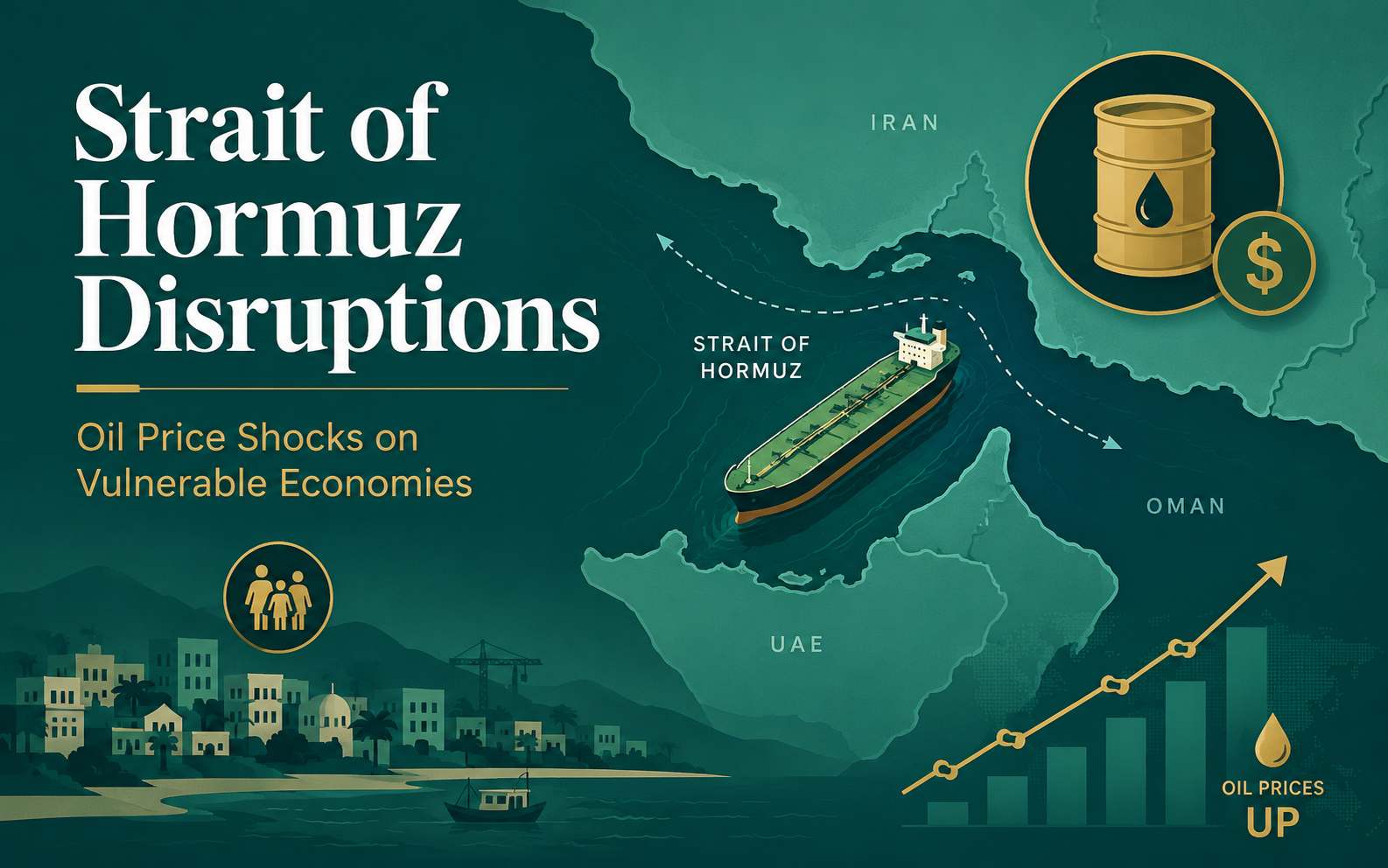
The Strait of Hormuz is one of the world’s most important maritime chokepoints for oil and refined petroleum products. When military tensions or shipping disruptions occur in this area, global energy markets react quickly. Supply concerns can push up crude oil prices, gasoline prices, freight costs, and broader energy-related expenses.
UNCTAD’s report shows that, after the recent military escalation, crude oil prices rose by more than 40%, while gasoline prices increased by more than 50%. These figures are particularly important because the impact of an oil shock is not evenly distributed across the global economy.
Advanced economies often have several buffers. They may have strategic reserves, deeper financial markets, stronger currencies, more diversified energy systems, and greater fiscal capacity. Vulnerable economies usually have far fewer options. They are more exposed to external price shocks and often lack the infrastructure needed to absorb them.
For many of these countries, higher oil prices do not remain confined to fuel markets. They quickly move through the economy, raising the cost of transportation, electricity generation, imported food, public services, and basic goods.
Vulnerable Economies Are Often Forced to Buy Oil from Abroad
The central point of the UNCTAD report is that most vulnerable economies are highly exposed to imported oil. Among the 75 economies analyzed, 65 are net importers of oil. This includes 86% of least developed countries and 87% of small island developing States.
This matters because countries that rely on imported oil cannot easily shield themselves from global price spikes. When the international price of oil rises, their import bills rise almost immediately. If their currencies weaken at the same time, the burden becomes even heavier.
A further problem is that these economies mainly import refined petroleum products rather than crude oil. According to the report, among the 65 net oil-importing vulnerable economies, crude oil accounts for only 2.2% of net oil imports, while refined oil products account for 97.8%.
This reflects a lack of sufficient refining infrastructure. Many vulnerable economies do not have the industrial capacity to import crude oil and refine it domestically. Instead, they must buy refined products such as gasoline, diesel, and other fuels directly from the international market.
That makes them particularly exposed to price volatility. They cannot easily capture value through domestic refining, and they have limited ability to cushion the impact of higher refined-product prices. In practical terms, this means that a global energy shock can quickly become a domestic inflation shock.
A Potential Additional Cost of More Than Billion a Year
UNCTAD estimates that, if oil prices rise by 50% and import quantities remain unchanged at 2024 levels, the annual oil import bill for these vulnerable net-importing economies could increase by $20.4 billion.
Of this total, least developed countries would account for $16.1 billion, while small island developing States would account for $4.3 billion.
At first glance, $20.4 billion may not seem overwhelming in the context of the global economy. However, the importance of this figure lies in its scale relative to the GDP, fiscal resources, and foreign-exchange capacity of the countries affected.
For some least developed countries, the shock is extremely large. UNCTAD estimates that the additional oil import cost from a 50% price increase would amount to 7.3% of GDP in Mauritania, 6.3% in Gambia, 5.0% in Burkina Faso, 4.8% in Liberia, and 4.3% in both Zambia and Lesotho.
An import-cost increase of this scale is not simply a trade issue. It is a macroeconomic shock. It can widen current account deficits, increase demand for foreign currency, weaken exchange rates, push up domestic inflation, and force governments to make difficult fiscal choices.
Small Island Developing States Have Even Fewer Escape Routes
Small island developing States are also highly exposed to oil shocks. According to UNCTAD, a 50% increase in oil prices would raise the oil import bill by the equivalent of 5.8% of GDP in Vanuatu, 5.2% in Maldives, 4.4% in Tonga, 4.2% in Mauritius, 3.2% in Fiji, and 3.0% in Samoa.
These economies face a specific vulnerability: geography. Island economies often depend heavily on imported fuel for electricity generation, shipping, aviation, tourism, and food imports. Transport costs are structurally high, and alternative supply routes are limited.
When fuel prices rise, the effects can spread rapidly. Imported food becomes more expensive. Electricity generation costs rise. Hotels and tourism-related businesses face higher operating costs. Airfares and shipping charges may increase. Household purchasing power declines.
For tourism-dependent economies, the impact can be even more complex. Higher aviation fuel costs can reduce travel demand, while higher domestic energy prices increase operating costs for local businesses. This creates a double pressure: rising import costs on one side and weaker foreign-exchange earnings on the other.
The Risk Is Not Only Price — It Is Also Supply
The Strait of Hormuz shock is not only about higher prices. For some countries, it is also about physical supply security.
UNCTAD identifies several vulnerable economies that source a significant share of their oil imports from the Hormuz region. The region, as defined in the report, includes Bahrain, Iran, Iraq, Kuwait, Qatar, Saudi Arabia, and the United Arab Emirates.
Seychelles is the most exposed, sourcing 99.0% of its oil imports from the Hormuz region. Uganda sources 61.5%, Mauritius 58.3%, the United Republic of Tanzania 56.0%, Zambia 44.7%, Maldives 43.1%, and Mauritania 43.0%.
For these countries, disruptions in the region may create two simultaneous challenges. First, prices may rise. Second, supply routes may need to be adjusted.
Securing alternative suppliers is not always easy. It may require new contracts, longer shipping routes, higher freight costs, additional foreign currency, and sufficient port and storage capacity. Smaller and poorer economies often have weaker bargaining power in global commodity markets, especially during periods of stress.
This means that a disruption in the Strait of Hormuz can create both a price shock and a supply shock. That combination is particularly dangerous for countries with limited reserves and narrow fiscal space.
How the Shock Spreads Through the Economy
The UNCTAD report highlights four major channels through which the oil shock can affect vulnerable economies.
The first channel is higher direct costs. Rising oil prices increase fuel and freight costs. Since many goods depend on transport and energy, higher fuel costs raise the overall cost of goods across the economy.
The second channel is broader inflation. In economies that rely heavily on imported fuel, higher oil prices can quickly increase the cost of living. Poor households are often hit hardest because they spend a larger share of their income on essentials such as food, transport, and energy.
The third channel is fiscal pressure. Governments may feel compelled to protect households from fuel-price spikes by using subsidies, tax reductions, or price controls. However, these measures require fiscal resources. If governments spend more on fuel support, they may have less room to invest in education, healthcare, infrastructure, climate resilience, or long-term development.
The fourth channel is slower economic growth. Higher oil import bills can widen current account deficits and put pressure on exchange rates. Currency depreciation can make imports even more expensive, adding to inflation. Central banks may respond with higher interest rates, which can tighten credit conditions and reduce investment and consumption.
For economies with limited fiscal space, these pressures can reinforce one another. Higher fuel prices create inflation. Inflation weakens purchasing power. Currency pressure raises import costs. Fiscal support increases budget stress. Tighter financial conditions slow growth. The result can be a negative cycle that is difficult to break.
This Is an Energy Security Issue — But Also a Development Finance Issue
The key lesson from UNCTAD’s report is that disruptions in the Strait of Hormuz should not be viewed only through the lens of oil prices or geopolitical risk. They should also be understood as a development finance issue.
For advanced economies, oil-price increases are often discussed in terms of inflation, central bank policy, and consumer prices. For vulnerable economies, the same shock can determine whether governments can maintain schools, hospitals, transport systems, food support, and basic public services.
This is why international policy responses need to go beyond monitoring oil markets. Vulnerable economies may require emergency financing, liquidity support, targeted fuel-import assistance, and debt-management flexibility. They also need longer-term investment in renewable energy, storage infrastructure, port capacity, energy efficiency, and supply-chain diversification.
Reducing exposure to imported fossil fuels is not only a climate-policy objective. For vulnerable economies, it is also a macroeconomic stability strategy. The less dependent a country is on imported fuel, the less vulnerable it is to distant geopolitical shocks.
Implications for Global Investors and Policymakers
For investors, the report is a reminder that energy chokepoints can have wide macroeconomic consequences. Oil shocks can affect sovereign risk, foreign-exchange stability, inflation expectations, debt sustainability, and growth prospects in emerging and frontier markets.
Countries with high fuel-import dependence, weak fiscal positions, low foreign-exchange reserves, and high exposure to the Hormuz region are likely to be more vulnerable. In such economies, a rise in oil prices can quickly translate into balance-of-payments pressure and political strain.
For policymakers, the message is equally clear. Energy security cannot be separated from development policy. Short-term relief may be necessary, but long-term resilience requires investment in domestic energy systems, diversification of suppliers, and stronger fiscal buffers.
The poorest countries should not be left to absorb the cost of geopolitical shocks that originate far beyond their borders. Without support, an oil shock can deepen existing vulnerabilities and delay progress toward sustainable development.
Conclusion
Disruptions in the Strait of Hormuz are a global energy risk, but their burden is not shared equally. The heaviest impact falls on countries that are highly dependent on imported oil, have limited fiscal space, and have large vulnerable populations.
UNCTAD’s report shows that the issue is much broader than oil prices. It is about poverty, inflation, fiscal stability, exchange rates, growth, and international support.
For the world’s most vulnerable economies, an increase in oil prices is not simply a market fluctuation. It can directly affect the price of food, the cost of transport, the availability of public services, and the ability of governments to invest in the future.
The Strait of Hormuz is geographically narrow, but its economic consequences are global. When this chokepoint comes under pressure, the effects are felt most sharply by those with the least capacity to absorb the shock.
Source: UN Trade and Development, “Strait of Hormuz Disruptions: The burden of oil price shocks on vulnerable economies,” 2 June 2026.