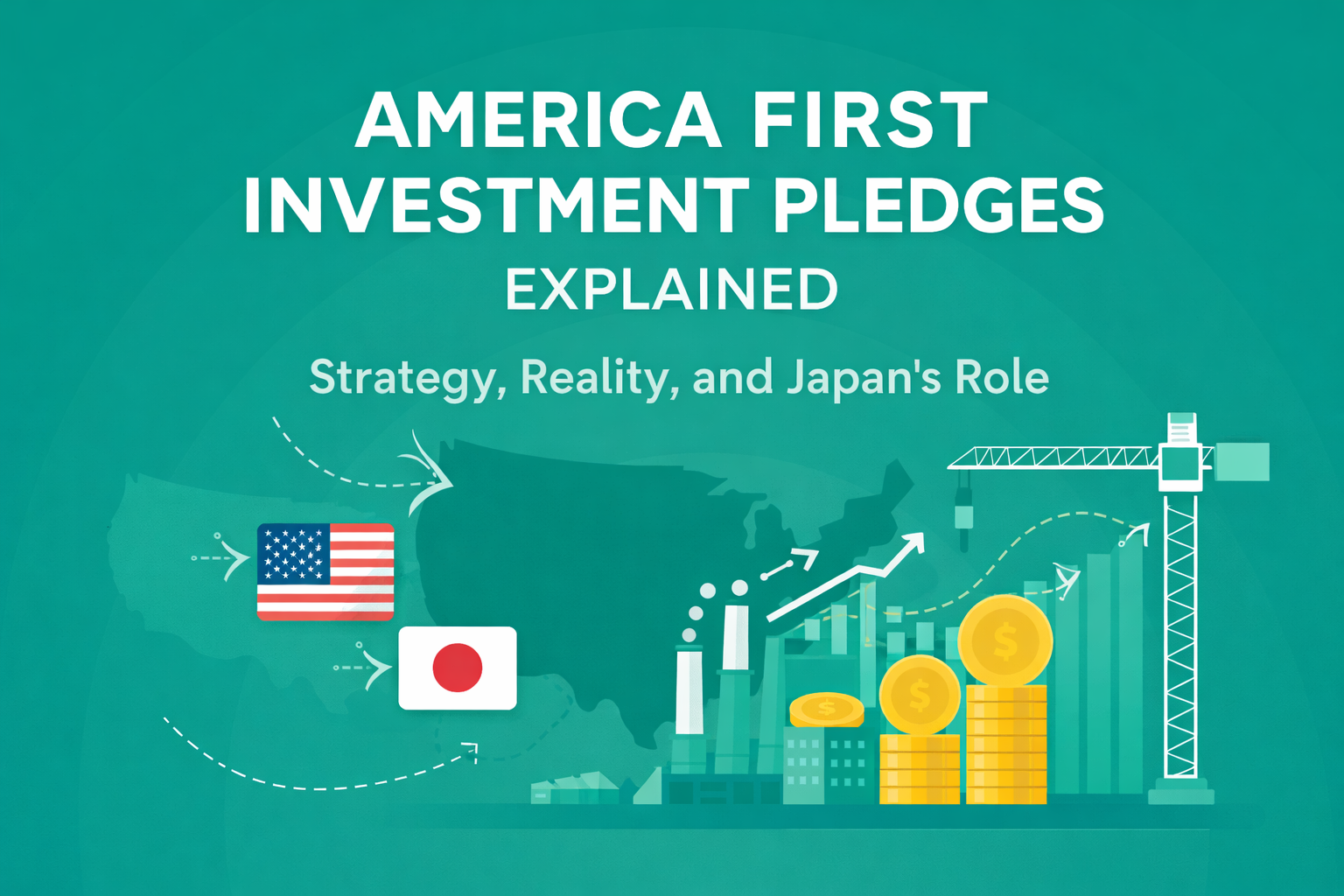
— Are They Economic Commitments or Strategic Bargaining Instruments?
- Introduction: Moving Beyond the Illusion of Headline Numbers
- 1. Investment Pledges Are Not Fiscal Spending Commitments
- 2. Trump-Era Economic Diplomacy as Structured Bargaining
- 3. Measuring Feasibility: The “Ability to Pay” Framework
- 4. Japan’s Strategic Position: Constraint-Optimized Statecraft
- 5. Asymmetry Within the Alliance System
- 6. Macroeconomic Implications: Allocation Over Efficiency
- Conclusion: Why This Report Truly Matters
Introduction: Moving Beyond the Illusion of Headline Numbers
Few elements of recent U.S. economic diplomacy are as frequently misunderstood as the so-called investment pledges announced under the “America First Investment” (AFI) framework. Figures reaching hundreds of billions—or even trillions—of dollars have prompted a predictable reaction: skepticism over fiscal feasibility, accusations of political exaggeration, and questions about whether such sums can ever be “paid.”
The central contribution of the recent policy brief by the Peterson Institute for International Economics (PIIE) lies precisely in dismantling this flawed line of questioning. The report does not ask whether these pledges are “affordable” in a narrow budgetary sense. Instead, it reframes the issue entirely: what do investment pledges actually represent in the context of modern statecraft?
This reframing is what makes the report analytically exceptional.
1. Investment Pledges Are Not Fiscal Spending Commitments
The most important conceptual clarification offered by the PIIE report is that investment pledges are not equivalent to government expenditures.
Rather, they should be understood as:
- Declarations of capital-mobilization capacity, not cash transfers
- Upper-bound figures aggregating potential private investment, trade flows, and financial intermediation
- Political and strategic signals embedded in bilateral negotiations
Once this distinction is made, many apparent paradoxes dissolve. It becomes clear why governments can credibly announce massive figures without budgeting for them, why full execution is neither expected nor required, and why partial realization can still be deemed a “success.”
This is not accounting trickery; it is a fundamentally different category of commitment.
2. Trump-Era Economic Diplomacy as Structured Bargaining
A second major strength of the report is its refusal to treat Trump-era policy as improvisational or incoherent. Instead, PIIE correctly identifies a systematic negotiation architecture in which multiple policy tools operate as a unified package:
- Tariffs (Sections 232 and 301)
- Export controls on advanced technologies
- National security designations
- Targeted investment inducements
Taken together, these instruments form what can best be described as state-to-state project finance by other means. The United States leverages market access and security guarantees to redirect global capital toward domestic priorities—manufacturing, energy, AI, defense, and critical supply chains.
Under this framework, investment pledges function less like contracts and more like collateralized political understandings.
3. Measuring Feasibility: The “Ability to Pay” Framework
The analytical core of the PIIE report is its introduction of an “Ability to Pay” metric, which evaluates each partner country’s capacity to support its pledge without assuming new fiscal outlays.
This metric combines three components:
- Reallocation potential of outward FDI flows
- Capacity to redirect imports toward U.S. suppliers
- Availability of external public assets (reserves, sovereign wealth funds, official balance sheets)
The conclusion is both sober and illuminating:
no country is expected to finance its pledge with entirely new resources. Execution, where it occurs, will largely reflect a geographic reshuffling of existing global investment, favoring the United States over alternative destinations.
The true differentiator among countries is not willingness, but structural flexibility.
4. Japan’s Strategic Position: Constraint-Optimized Statecraft
Japan’s treatment in the report is particularly insightful.
Despite high public debt and limited fiscal space, Japan possesses unique structural advantages:
- The world’s largest net international investment position
- Deep, stable outward FDI flows
- Powerful government financial intermediaries (e.g., policy banks and export credit agencies)
- A governance model that preserves private investment discretion while offering public risk mitigation
As a result, Japan’s pledge—headline figure notwithstanding—represents a highly elastic commitment. It is designed to preserve alliance credibility while minimizing fiscal exposure, allowing execution to scale gradually, selectively, and conditionally.
Far from being overextended, Japan emerges as a sophisticated actor operating efficiently under constraints.
5. Asymmetry Within the Alliance System
One of the report’s understated but crucial insights is that U.S. allies are not equally positioned.
- Korea faces tighter trade dependence and fewer diversification options
- The EU is constrained by internal legal and political fragmentation
- Japan retains financial optionality and temporal flexibility
This reveals a hierarchy of negotiation resilience within the alliance network—an uncomfortable reality often obscured in official discourse but essential for realistic policy analysis.
PIIE succeeds where diplomatic language cannot: it makes this asymmetry analytically explicit.
6. Macroeconomic Implications: Allocation Over Efficiency
The report also resists the temptation to overstate global welfare gains. In fact, it is clear-eyed about the trade-offs:
- Short-term upward pressure on the dollar
- Potential widening of the U.S. current account deficit
- Long-term expansion of U.S. productive capacity
- Reduced global allocative efficiency due to politically directed capital flows
AFI is therefore best understood not as a growth-maximization strategy, but as a geopolitical reallocation policy—one that prioritizes national resilience and strategic control over textbook efficiency.
Conclusion: Why This Report Truly Matters
The enduring value of this PIIE report can be distilled into a single achievement:
It reframes massive international investment pledges not as fiscal promises or moral obligations, but as instruments of financial structure and strategic bargaining.
By doing so, it rescues the discussion from naïve arithmetic and places it firmly within the domains of international political economy and applied finance.
For policymakers, particularly in Japan, the report provides something rare and invaluable:
a rigorous justification for restraint. It clarifies not only what must be done, but—more importantly—what need not be done, even under intense political pressure.
That intellectual clarity is what makes this report genuinely exceptional.